Lexicon Event II
London
Lexicon II brought together scholars, artists, writers and activists to unpack two interrelated terms emerging from the critical lexicon: "hostility" and "infrastructures of care”. The event took place across multiple locations in London and via multiple formats. As borders infiltrate everyday life, conjuring up diffused atmospheres of surveillance, Lexicon II reflected on the concept of ‘hostile environments’, through the prism of race and their longer historical rootedness in colonialism, as well as how various practices can be mobilised to account for and contest these hostile environments, opening up spaces of resistant care.
Lexicon II, was the second of a short series of events organised by LIMINAL around a set of key terms that we aim to (re-)define collectively as part of the critical lexicon we are developing. It was held in London in February 2025, a three-day event, it took place via multiple formats and across multiple locations – from the CRA, Goldsmiths, to Turf Projects in Croydon1 – site of the UK Home Office, to the David Lean Cinema and the Royal College of Art (RCA). Its aim was to bring together scholars, artists, writers and activists to unpack two interrelated terms: "hostility" and "infrastructures of care”.
In public discussions, the immigration policy referred to as the hostile environment is often conveniently confined to 14 years of Conservative Party rule in the UK. Yet, a “generalised atmosphere of hostility” (Couze Venn) can be said to have characterised Western governments approach to immigration for decades, and even more now so with the far-right in power in many places around the world. Starting from the situation in the UK but situating it within a wider historical and geographical framework, on day one, participants gathered at the CRA in Deptford Town Hall2 to hear from a panel of activists with deep knowledge and experience in campaigning against racist borders to reflect on the insidiousness of hostile environments and the practices needed to dismantle them.
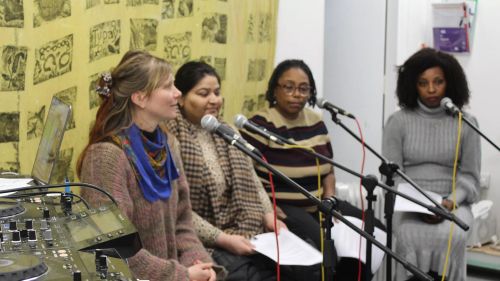
The panel was composed of; Fizza Qureshi -CEO, Migrants’ Rights Network- who reflected on MRNs work on the ‘Hostile Office’ which evidences how the UK Home Office is ‘racist by design’ and the dehumanising policies and language adopted by the UK Home Office, rooted in colonial histories. She drew attention to how ‘care’ may be weaponised and used as a means of enacting hostility, such as in the ‘smash the gangs’ as a benevolent act, a means to ‘save’ people. Alice Elliot - Senior Lecturer in Anthropology, Goldsmiths also raised the issue of ‘care’ being used to ‘protect’ people from smugglers and the fallacy of care as security. Gee Manoharan -Co-Director of Policy and Influencing, AVID, who has himself lived experience of the hostile environment in the UK hauntingly spoke of how it may be ‘felt in your bones’ or experienced as smell, and of how care can be found in acts of solidarity, such as AVIDs work of visiting detainees. Gracie Mae Bradley -Writer, policy expert, campaigner, and James McCune Smith Scholar, Glasgow University, shared her work with Liberty on the Care Don’t Share report and drew attention to the pervasiveness of the hostile environment, how it affects all racialised people, not just those considered ‘migrants’.
Day two saw participants travel to Croydon, to the homegrown artist space3 Turf Projects. In the duality of its arrival harbour for historical and recent migration, as well as a symbol of brutal practices of expulsion (as seat of the infamous Home Office visa and immigration offices and a borough undergoing violent gentrification), Croydon embodies the practices of care and hostility. Moving across its urban landscapes and dwelling in specially commissioned soundscapes, participants in this workshop reflected upon the imposed precarity of life, forms of everyday bordering, as well as practices of solidarity. Interventions involved the Forever Temporary exhibition by artists Nicolaas van de Lande and Lucía Scarselletta, a creative storytelling session from the cracks of the hostile environment, and a meditation on care-full practices in academia and beyond entitiled 'Where the Wind Blows Them by Rebekka Hölzle and Rachel Margetts with Amanda, Faiza, Fahmida, and Mary – recording available here; and a talk by Akil Scafe Smith – Resolve Collective who gave a potted history of the urban inequalities in Croydon and the spaces of care that have emerged in response.
The evening saw a film screening at the David Lean Cinema in Croydon4. A trio of films traversing the city of London which together present three distinct and experimental methods of mapping and mobilising against localised yet globally entangled atmospheres of racialized hostility, from London’s early emergence as a global city to the present day.
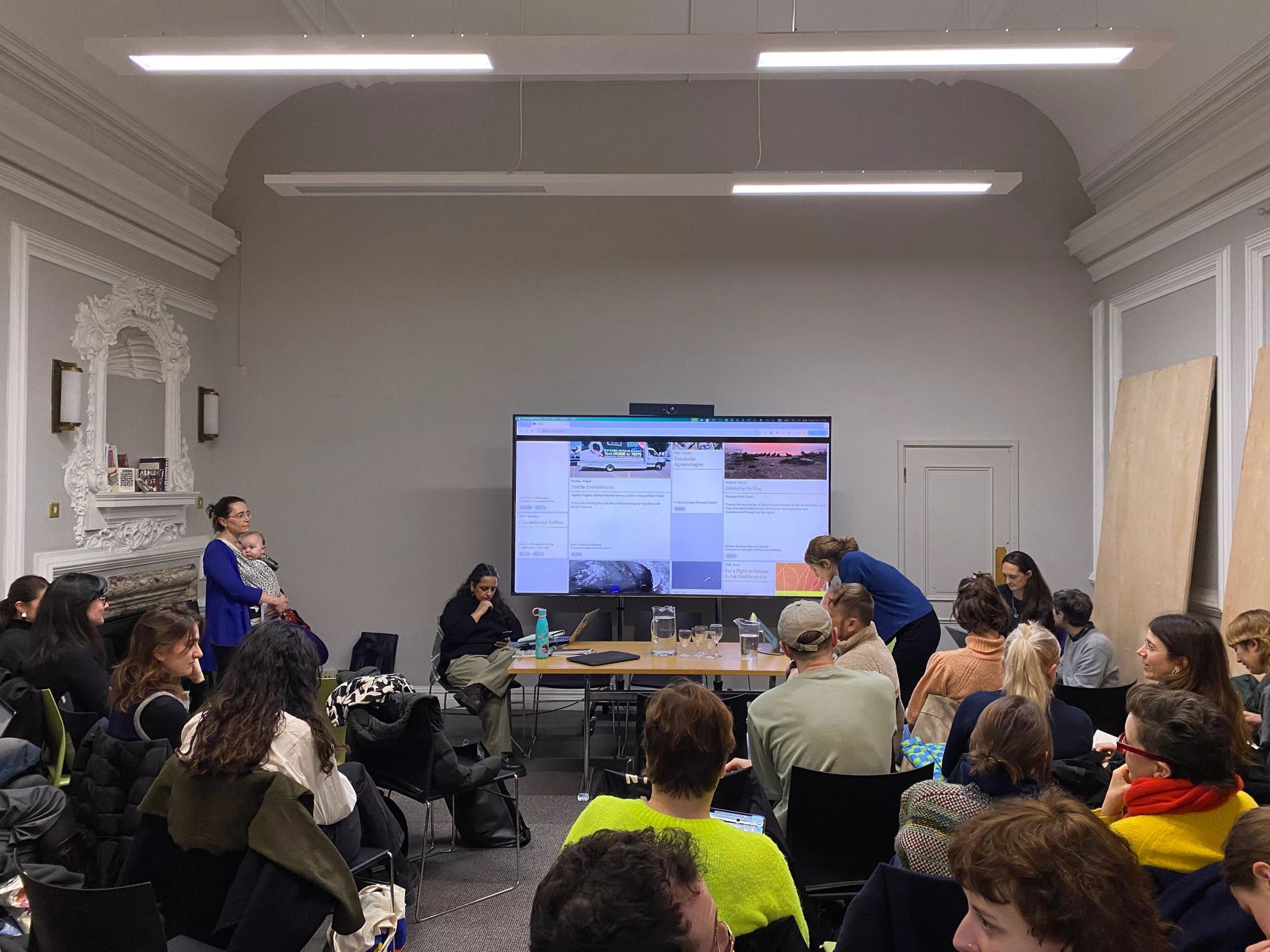
The third and final day saw a gathering at the RCA organised in collaboration with the RCA MA City Design and co-hosted by Charlotte Grace and Dubravka Sekulic. Speakers sought to redefine care and hostility through a collective discussion. The day involved the following discussions:
Speaking on: ‘compliancy and the intimate border’ were Yasmin Gunaratnam - Professor in Social Justice, Centre for Public Policy Research, Kings College, University of London who spoke of ecologies of fear, fragmentation and the connections with the ongoing Israeli genocide in Gaza. Helen Brewer, writer, researcher, and Associate Lecturer at the Royal College of Art who spoke of the making of the Compliant Environment through the internal management of migrant “care & custody”. Compliance is conceptualised as a form of self-regulatory violence, disciplining and orientating migrants toward potential economic and social inclusion for the control and order of the internal border.
In conversation on A heavy non presence’- state ‘care’ and strategies for survival the writer and editor Derica Shields and Kodwo Eshun – writer, theorist and filmmaker, and Lecturer in the Centre for Research Architecture discussed and reflected on Derica’s oral history project A Heavy Nonpresence and connections with the Otolith film Infinity minus infinity (2019) - which engages with the compounded duress of the hostile environment, and the film On Duty (1983), based on the documentary testimony and the fictionalisation of the experiences of Rita Maxim, a Dominican born auxiliary worker and union official, during the campaign against the Thatcherite privatization of the NHS.
Speaking to ways in which we might redefine practices of care were Leah Bassel – Professor of Politics and International Studies at the Centre for Trust, Peace and Social Relations, University of Coventry, who spoke about the Permanent Peoples’ Tribunal (PPT) hearing, ‘The hostile environment on trial’, which took place in London in 2018. Valeria Graziano a cultural theorist and organizer, researching militant practices of work refusal and repair spoke about Pirate Care – a necessary practice of disobedient care in the face of the increasing attacks on the freedom to simply care for one another by the powerful, and the criminalisation of acts of solidarity. Travis Van Isacker, an activist and Senior Research Associate at the ESRC Centre for Sociodigital Futures at the University of Bristol spoke about infrastructures of care in the practices of solidarity for those criminalised by the ‘stop the boats’ discourse and polices in the UK as well as the damaging nature of the polices of the UK government.