Lexicon III: Extractive Frontiers
Senegambian Coast
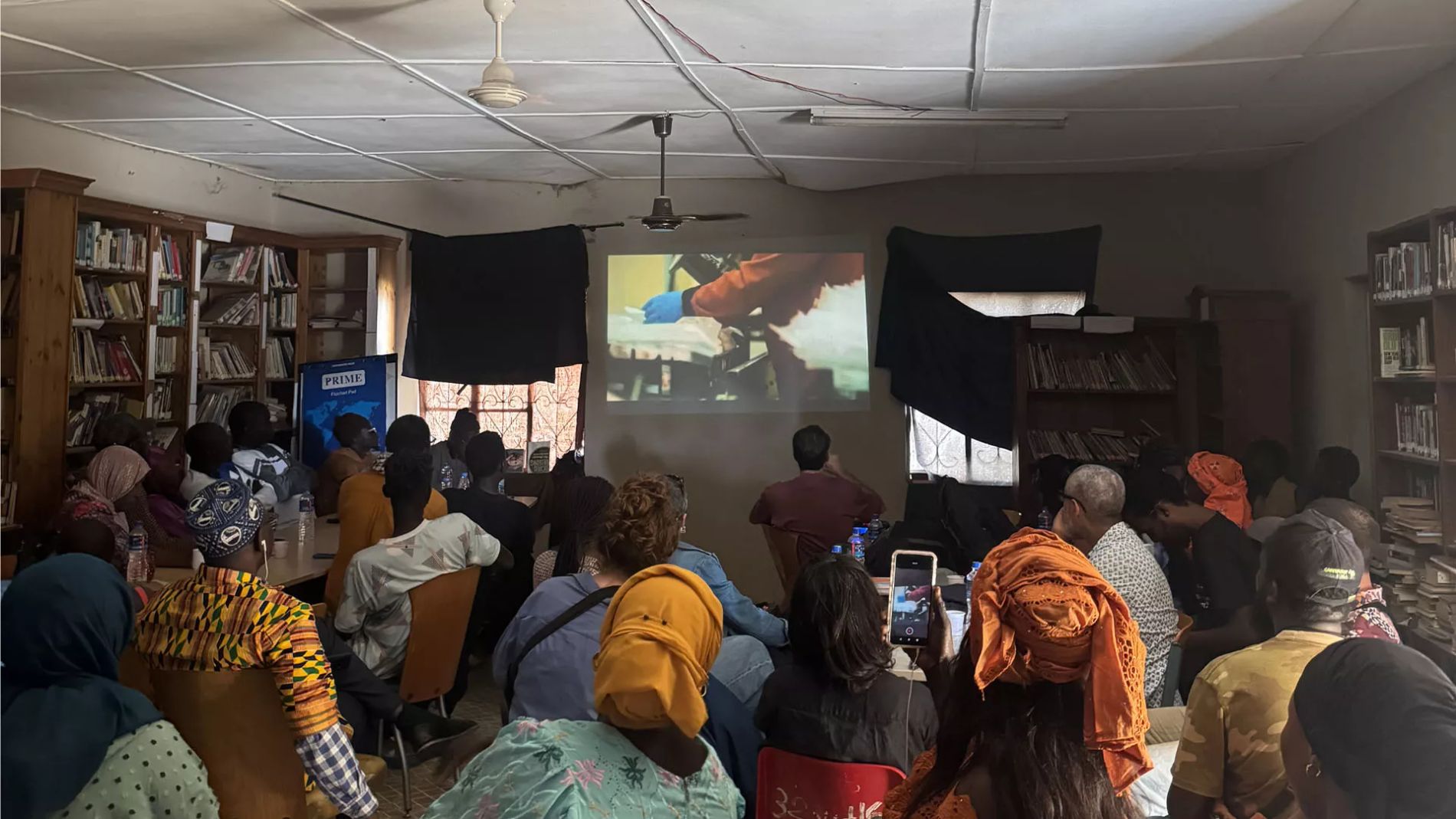
Film screening at the Sanyang Community Library
A four-day event held in March 2026 in The Gambia, Lexicon III brought participants together to unpack the term “extractive frontiers”. The aim was to reflect from an intersectional lens on extractive practices and their entanglements with im/mobility and bordering practices. It involved a mixture of public and more internal moments and featured different formats (scholarly presentations, activist gatherings, poetry readings, workshops with research participants as well as children, etc.) addressing different audiences. In addition to the LIMINAL team, participants included a mixture of academics, artists, writers, fishermen and fish retailers, fishing union representatives, activists, and journalists based in The Gambia, West Africa and beyond.
Lexicon III, was the third and final of a short series of events organised by LIMINAL around a set of key terms that we aim to (re-)define collectively as part of the critical lexicon we are developing. It was held in The Gambia in March 2026, a four-day event, it took place via multiple formats and across multiple locations – from The University of The Gambia, The Orange Library, and Sanyang community library, to walking tours of the beaches and fishing infrastructure. Its aim was to bring together scholars, artists, writers and activists to unpack the term ‘extractive frontiers’ and to reflect upon the neocolonial roots of extractive practices and their entanglements with im/mobility and bordering practices. Extraction does not refer here only to the plundering of raw materials from the earth, but to a wider set of operations including the mining of data and information from migrants’ bordered bodies. A multilingual event, translation was amazingly provided by writer and interpreter Musa Bah, as well as informally by other participants between Mandinka, Wolof, English and French.
Day one, commenced at The University of The Gambia1, for a Research symposium entitled ‘Rethinking Extraction & (im-)mobility’ Institutional greetings were given by Professor Lamin K M Fatty, Dean of School of Agriculture and Environmental Science, UTG. The first panel focused upon Extracting (im-)mobility, and saw Viola Castellano and Rhoumour Ahmet Tchilouta present work on this issue, with a response from Safiatou Drammeh moderated by Sarah Walker. The second panel focused upon ‘Excavating Extraction & Bordering’ with Hassan Ould Moctar, Akosua Darkwah, and Abdourahmane Seck with a response from Lorenzo Pezzani. Moderated by Fatou Jobe
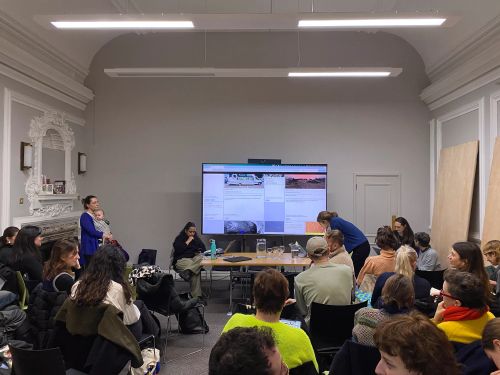
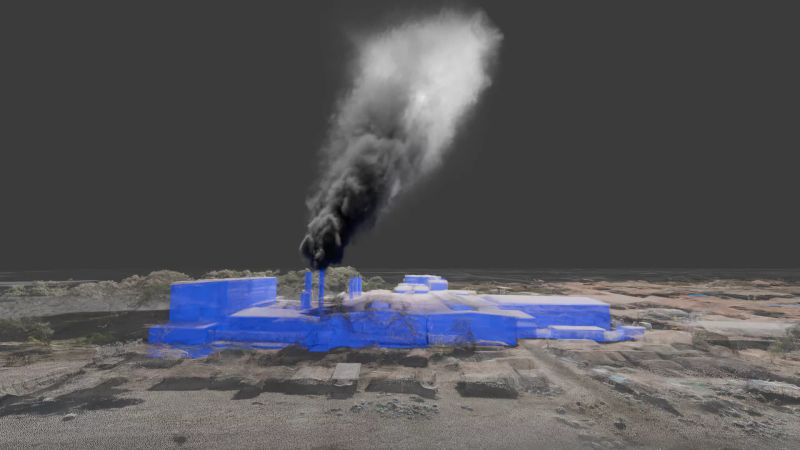
The event ended with a screening of ‘Emptying the Sea’, a short film produced by LIMINAL, introduced by Alagie Jinkang who worked on the film and the research behind it. This was followed by a lively debate on the damaging impacts of the practices of the fishmeal fish oil factory and the interconnection with im/mobility along the coastal communities in The Gambia. The day concluded on the beach, around the fire with performances by Kangkillin Drumming group and Ebrima Janha, a local poet from Sanyang, with participants sharing both their own poems, and those of others, including June Jordan’s compelling Intifada Incantation: Poem #8 for b.b.L
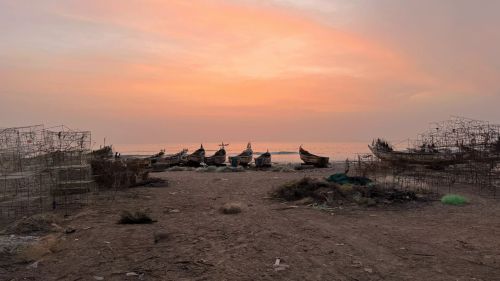
Day two saw participants travel to Tanji Beach2, landing site and fish market – for a guided walk led by Alagie Jinkang and Famara Jawara, two local activists and LIMINAL researchers working on the socio-economic impacts of fishmeal fish oil production on coastal communities in The Gambia. The afternoon involved a Community event on the socio-environmental impacts of FMFO and practices of resistance held at Sanyang Community Library3 with research participants, local activists and event participants. Alagie Jinkang and Famara Jawara introduced the event, and the work behind their documentary ‘Last Calabash’ that was then screened. This was followed by a presentation of LIMINAL Children’s book4 Halimatu by Clara Dublanc and co-authors Binta Bayo, Fatou Fadera, Oumie Fadera, Fatou Jawara, Lisa Fattty, Antonet Jarjou, Awa Jase, Fatima Mendy, Halimatu Li, Maryam Mendy and Binet Sambu.
Day three saw participants gather for a community event on the relation between 'Extractivism, Displacement & Bordering Practices', at the Dalaba Ecolodge in Gunjur5. Activists and academics working on migration, fishing and environmental injustices came together to discuss, share and think through strategies and practices of resistance against overfishing and border externalisation. In light of these ongoing and intertwined injustices, participants reflected on the diverse forms of resistance that have been adopted and how can we work together to combat extractive practices and build solidarities.
The morning commenced with discussions centred on Practices of resistance against overfishingled by Ahmed Manjang, CETAG , Bassirou Diarra – Environmental Justice Foundation and Mbor Mbengue and Baye Biram Fall of Taxawu Cayar Collective who spoke of their success in combating the polluting activities of a FMFO factory in Senegal and the collective means in which they achieved this success. The afternoon involved discussions of Practices of resistance against Displacement / Border Violence led by Saliou Diouf – BozaFii, Babacar Ndiaye – Alarm Phone and Aminata Mboye, Ndiare Ndao and Ousseynou Diop of Collectif Des Victimes de l’Émigration au Sénégal (COVES). The day ended with a CommemorAction on Gunjur beach. Here, on yet another beach from where many have departed and disappeared or lost their lives, participants came together to engage in remembrance and protest against all the lives lost or missing due to the violence of border regimes and extractive practices.
The fourth and final day was held at The Orange Library, and saw participants discuss ‘Artistic Practices Against Extraction’. Taking its name from the poem The Orange by Wendy Cope, The Orange Library is an inclusive space that celebrates poetry and prose written by Black, Indigenous, and People of Colour. Ben Camara, founder and librarian gave a guided tour of the space and introduced some of the books and activities of the library. During this session, participants reflected on how artistic practices, such as film (César Schofield Cardoso: Agu Rixu (Rough Waters), attunement (Henriette Guenkel), sonic landscapes and participatory methods such as cooperative anti-racist clothing by Top Manta6 collective might act as a means to imagine otherwise, to create space for reflecting on alternative and radical imaginaries of the future and to move away from extractive epistemologies.
Team & funding
Core Team
Extended Team
Collaborators
Funding
Resources
Reports
Changing Markets Foundation, “Feeding a Monster; how European aquaculture and animal industries are stealing food from West African communities." Changing Markets LTD, 2021. ↗